
Instagram Algorithm Changes: 2026 Update
Which algorithm signal is your account missing? Find out free.
Add your Instagram and we check your real account against the 2026 algorithm. Free, no password needed.
Instagram rewrote its distribution algorithm in early 2026 around four buyer-intent signals: DM shares, saves, watch time, and profile clicks. Likes and follower count dropped away as proxies for quality. Below is what changed, the time chart of how a post is scored from its first minutes onwards, the four weighted signals, and the adaptation GOSO runs on client accounts to restore reach.
What changed in the 2026 Instagram algorithm update
The 2026 Instagram algorithm update did not land as a single switch. It arrived as a run of changes, each one shifting more weight away from vanity metrics and toward buyer-intent signals. Seeing the order they arrived in helps explain why accounts that were performing in late 2025 lost reach without changing anything they were doing.
Shift one, DM shares gained weight. Posts being sent privately in DMs started reaching wider audiences. There was no public announcement, so the first evidence was in the accounts GOSO manages: content that prompted DM shares kept climbing, while content that collected likes plateaued.
Shift two, saves rose up the order. Instagram's own creator education frames saves as evidence that a post has lasting utility, and the reach followed. Posts structured as reference guides, frameworks, and checklists began outperforming entertainment content, even where the entertainment content collected more raw likes.
Shift three, follower count stopped carrying reach. Watch time, profile clicks, and saves became the primary distribution signals, and follower count fell away as a proxy for quality. This is the shift most accounts felt as a drop: creators who had relied on a large following to hold reach found their posts stuck inside their follower bubble.
The net result: accounts that do not produce the four new signals now sit well below the reach they had in 2025, while accounts actively producing DM shares, saves, and watch time held or grew. The difference is structural, not random, which is why it does not correct itself with time.
The 4 signals the Instagram algorithm 2026 weights heaviest
-
DM shares (highest weight)
When a viewer sends your post to one specific friend in a DM, that is the strongest buyer-intent signal Instagram measures. The mechanism is simple: sharing in a DM requires the sender to think of a specific person who needs this. That specificity is what Instagram cannot fake or inflate, which is why it trusts the signal above the rest. Design every post for one person to send to one friend, not for a broadcast audience. See our deep dive on DM shares as the new ranking signal.
-
Saves (second highest)
Saves signal that a post has future utility. Educational frameworks, step-by-step templates, named reference lists, and "save this for later" reveals get saved at high rates. A post without an obvious reason to save it rarely breaks out of the follower bubble. The practical rule: every post should have at least one element a viewer would want to revisit. A specific stat, a tool they have not heard of, a process with more than three steps. Single-idea inspirational posts and quotes almost never get saved.
-
Watch time on Reels
Watch time is the only one of the four signals Instagram measures automatically, without any action from the viewer, so it is the most trustworthy quality indicator in Meta's model. The first three seconds of a Reel now decide whether most viewers stay to the end. Hooks that start mid-action, reveal-first structures, and pattern interrupts consistently outperform talking-head intros and slow builds. See our Reels not getting views guide for the hook formulas that work in 2026.
-
Profile clicks from the post
When a viewer clicks through to your profile from a post or Reel, Instagram reads this as: the post did its job and the account is worth exploring. Profile clicks correlate with follow conversion rate, which is the downstream signal Instagram uses to confirm an account is growing a real audience. The 2026 algorithm rewards posts that drive profile visits, not just engagement in place. End-of-Reel calls to action that say "more of this on my profile", and captions that reference a specific piece of content on the account, both pull far better than a generic CTA.
Fix your account for the 2026 algorithm now, for free.
Add your Instagram and we read your real account against all four, free, then show you what to fix first.
The Instagram algorithm 2026 time chart: how your post is scored by window
The 2026 algorithm does not evaluate a post as a single event. It runs three evaluation windows, and each one gates access to the next. Understanding the time chart is the single most important operational insight for restoring reach, because most accounts lose in window one and never recover.
Window 1, the first minutes: Instagram shows your post to a small sample of your existing followers. It measures the ratio of the four signals (DM shares, saves, watch time, profile clicks) against impressions. If your signal ratio clears the threshold for your account size, the post moves to window two. If it does not, the post is effectively capped at your follower audience. Most reach problems start here. Weak engagement in window one caps distribution for the life of the post.
Window 2, the first few hours: Posts that passed window one get tested with a small non-follower audience. Instagram shows the post to accounts that engage with similar content and measures the same four signals. This is the Explore-feed test. If the post performs well with non-followers, it enters the broader distribution pool. This window is where content that travels separates from content that merely "does well with your audience". To pass window two, the post needs hooks that work on cold audiences, not just on people who already know you.
Window 3, the first days: Posts that passed windows one and two get a second algorithm push, often surfaced in Explore, hashtag feeds, and suggested content. This window is where reach compounds. Most organic reach growth for strong posts happens here. Once a post is in window three, saves and DM shares continue to accumulate, signalling ongoing utility and keeping the post in distribution for longer.
The practical implication: posting time matters because it determines who is online in window one. Posting when your audience is active gives window one its best chance. GOSO's AI Engagement covers window one by delivering real engagement signals in natural patterns within minutes of every post, so every post gets a fair pass at window two.
What is the best posting strategy for the Instagram algorithm update 2026?
The 2026 algorithm rewards accounts that consistently produce the four weighted signals, not accounts that post most often. Frequency without quality now actively hurts distribution: posting below-threshold content lowers your account's average signal ratio, which reduces the starting distribution for all your future posts.
The posting strategy that works in 2026: three to four posts per week minimum, alternating Reels and carousels. Reels carry the highest potential reach because watch time is algorithmically measurable, but carousels drive the highest save rate. An account that posts two Reels and two carousels per week, each with a clear save trigger, a DM-share prompt in the caption, and a strong hook, outperforms an account posting seven times a week with no signal triggers.
Posting times: use Instagram Insights to check when your specific audience is most active. For most niches, this is Tuesday to Thursday between 7-9am and 6-9pm in the audience's primary timezone. These are the windows when window-one sample audiences are densest. Posting outside those windows does not disqualify a post, but it reduces the quality of the window-one sample.
Content format guidance for 2026: Stories do not directly feed the four signals (they live in a separate distribution bucket), but they drive profile clicks and DM conversations, which are the downstream indicators that build account trust. Use Stories daily for direct engagement and connection, but do not rely on them as your primary reach driver.
How to recover reach after the Instagram algorithm change: how long it takes
Most accounts recover within a couple of weeks if they address all three structural problems at once: hook quality (window one), signal triggers (saves and DM shares), and early engagement density (covering the window-one gap in those first minutes). Accounts that only address one of the three typically see partial recovery and plateau again.
The recovery sequence: start with the hook. Rewrite the first three seconds of every Reel and the first line of every caption to front-load a reveal, a specific claim, or a pattern interrupt. This improves window-one watch time and reduces immediate scroll-past. Once hooks are working, add save triggers to every post. Then close the early engagement gap with AI Engagement, which delivers the window-one signal density the algorithm needs to promote the post to window two.
Accounts that address all three usually see the first signs of recovery within their next few posts, not the very next one. Returning to pre-drop reach levels takes longer, because the algorithm reads a rolling average of your recent history rather than a single post. Judge the change over a fortnight of posting, not over one upload.
Get your 2026 algorithm plan now, free.
Chris Rowan, Founder and CEO, GOSO.io
Everything above is the method. Add your Instagram and we apply it to your real account, free, plus three AI agents that do the work.
Instagram policy and feature updates in 2026: pinned DM threads and activity status
The 2026 algorithm update came alongside two feature and policy changes that affect how you reach and communicate with followers. Neither is an algorithm change, but both intersect with reach and conversion strategy.
Pinned DM threads: Instagram introduced pinned DM threads in 2026, allowing users to pin up to three conversations at the top of their inbox. For brands and creators using DM-based sales, this is a meaningful feature. Prospects and clients who pin your conversation are more likely to respond, and a pinned thread signals a warmer relationship to the user. If you are running DM outreach, your first message should be warm and specific enough that the recipient wants to keep it accessible.
Activity status change: Instagram updated default activity status visibility in 2026. Users who do not follow each other and have not had a recent interaction can no longer see each other's active status by default. This affects cold DM response rate estimates. If you are using DM opens or response timing as a signal for sales follow-up, account for the fact that "inactive" no longer means the person is offline.
For a category-by-category comparison of the DM automation tools that work safely with these 2026 rules, see our guide to the best Instagram DM automation tools in 2026.
The 4-step adaptation for the 2026 algorithm (works across niches)
-
Audit your last 20 posts for the 4 signals
Instagram's Insights panel shows DM shares, saves, and profile clicks per post. Pull your last 20. Posts with high likes but almost no DM shares are in the old format. Posts with moderate likes and a handful of DM shares are in the new format. Study what your new-format posts have in common and build more of that. The audit takes under 30 minutes and immediately shows you which content style is already working with the 2026 algorithm on your account specifically.
-
Add a save trigger to every post
Every post should have at least one of: a numbered framework, a named list, a template the viewer can apply, or reference data with a specific stat. Hit two of those and the save rate climbs sharply. Add save triggers to the post itself, not just the caption: a graphic with steps, a carousel slide that summarises the key point, or an end-screen in a Reel that viewers will want to return to. The caption alone is not enough.
-
Write captions that prompt DM shares
Instead of "What do you think?", close captions with "Send this to [specific persona] who needs to hear it." Direct DM-share requests pull far more shares than passive engagement asks. The specificity is the key: "Send this to the friend still posting at 2pm for no reason" works better than "Agree?". The more precisely you describe the friend who needs this, the more the reader can picture a real person, and the more likely they are to send it.
-
Close the early-engagement gap in the first minutes
The first minutes after publishing shape lifetime reach regardless of algorithm version. GOSO's AI Engagement delivers real engagement signals in natural patterns within minutes of every post, covering the window the 2026 algorithm made decisive. The result is a stronger window-one signal ratio, which gives every post a genuine chance at window-two distribution. From $40/mo, no password needed, live in 30 seconds.
Or let GOSO's AI do it for you
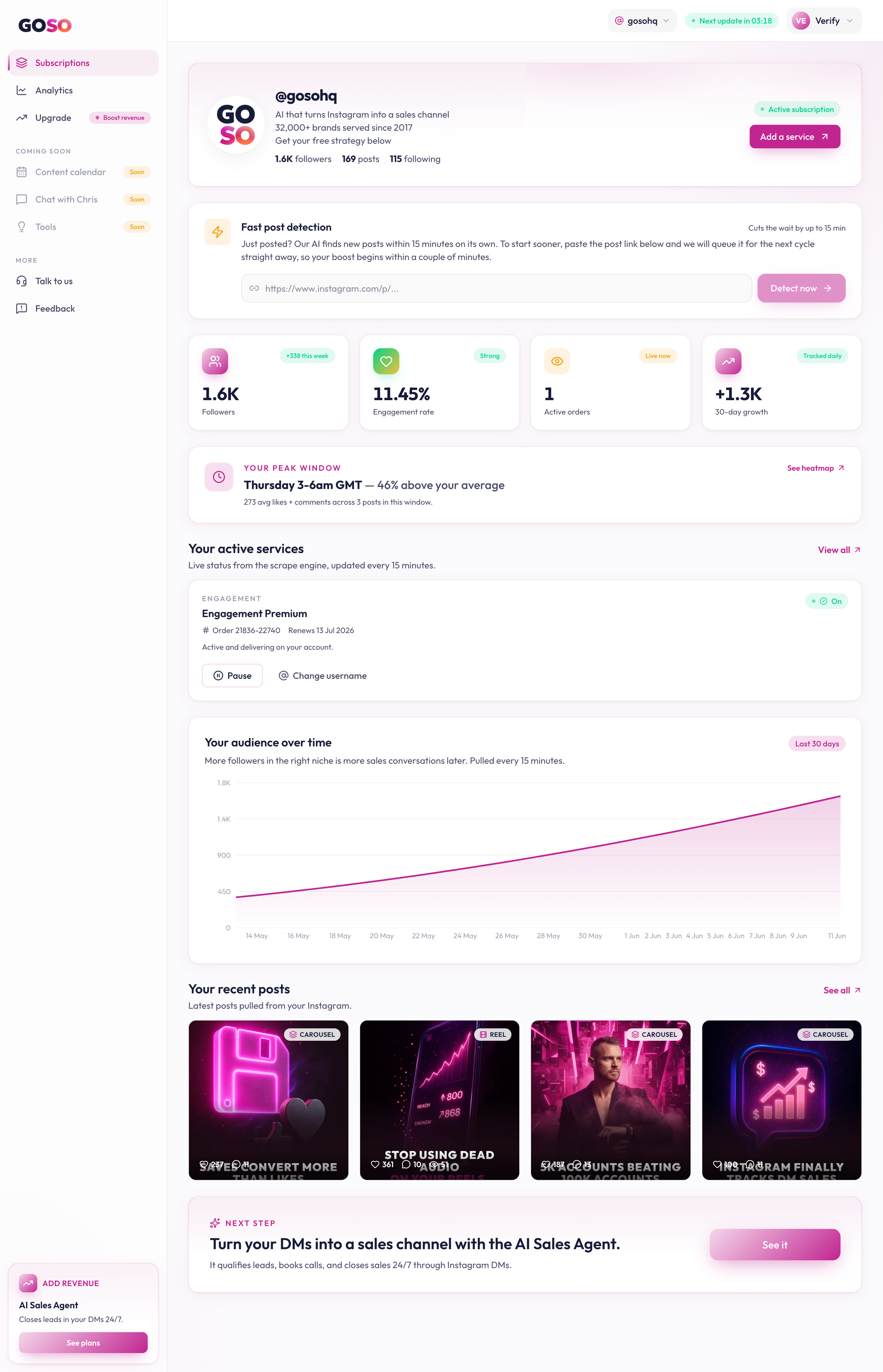
Inside your dashboard, you'll find:
- A live dashboard that tracks your reach, engagement, and revenue in real time
- AI Engagement that covers the first minutes after every post you publish
- AI Lead Generation that brings 300-500 buyer-intent followers a month
- Chat with Chris, your AI coach, for content ideas and growth questions any time
Run this on your own account, free
The adaptation above works across niches, but what to fix first depends on your content, your audience size, and how your account has performed. Add your Instagram and we scan your real account against the 2026 algorithm. Free. 30 seconds. No password needed.
Frequently asked questions
What actually changed in the Instagram algorithm in 2026?
Distribution rebalanced around four signals: DM shares, saves, watch time on Reels, and profile clicks. Likes and follower count lost most of their weight. Content that prompts private sharing and saving now travels furthest.
What is the Instagram algorithm 2026 time chart?
Three stages, not one moment. The first minutes decide whether a post travels past your followers. The next few hours test it on non-followers. Over the days that follow, strong posts compound.
Why did Instagram change the algorithm this year?
Private shares and saves show real intent in a way likes never did, and they are far harder to inflate. Instagram now ranks on the signals it can trust. The follower-vanity era is over.
Should I stop caring about likes?
Likes still count, but they carry far less weight than they did. A post with modest likes and a stream of DM shares now travels further than a post with lots of likes and none.
How do I make content that gets DM shares?
DM shares happen when a viewer pictures one specific friend who needs this now. Tactical content, named lists and before-and-after reveals drive them. Generic educational content gets saved but rarely sent.
How long does it take to recover reach after the algorithm change?
Most accounts see the first signs within two weeks, once hooks, save triggers and early engagement are fixed together. Fixing only one of the three usually gives partial recovery, then another plateau.